A seller you have never heard of is on your listing. The first question everyone asks is who they are. That question has a quick answer, and it is usually the less useful one.
The question that pays is where their inventory came from. A seller name tells you who to write to. The source tells you which of your own accounts or markets is letting product out the side door, and that is the only thing you can actually fix. Remove the seller without finding the source and a new name shows up on the same listing a few weeks later.
This guide walks through the investigation step by step, including the mistakes that turn a brand into the party Amazon acts against. For the bigger picture, how brands stop unauthorized sellers on Amazon covers where they come from and why structure beats takedowns.
Step 1: Read what Amazon already shows you
Click the seller name in the offer list and you land on their seller profile. Amazon told sellers in advance that starting September 1, 2020, it would display each seller's business name and address on the Amazon.com seller profile page.
Federal law now backs this up. The INFORM Consumers Act, which the FTC enforces, defines a high volume third party seller as one with 200 or more separate sales and $5,000 or more in gross revenue on a marketplace in any continuous 12 month period during the previous 24 months. Once such a seller reaches $20,000 or more in annual gross revenue on that marketplace, the marketplace has to disclose the seller's full name, physical address and contact information to consumers. There is one exception worth knowing. For a seller that operates only from home, the marketplace shows the country and, where it applies, the state instead of the full address.
So a seller moving real volume on your listing has its identity on the page. Record:
- The seller ID. It sits in the page address of the profile, after seller=. Business names change. The ID does not, and it is how you track the same account across months.
- The name and address exactly as shown. Screenshot the page with the date visible.
- The storefront. Look at what else they sell. That catalog is often the first real clue about sourcing.
- The offer details. Price, FBA or merchant fulfilled, and the date you first saw them.
The storefront deserves a slow look. Your brand next to other brands from the same distributor points toward that distributor or one of its retailers. A random mix of closeouts suggests liquidation lots. A seller that lists mostly your products, at volume, deserves the closest attention, because that often means a steady supply relationship with someone in your channel.
Step 2: Turn the name into an entity
The business name on the profile is a legal entity, and US entities leave a public trail. Search the name in the business registry of the state shown in the address. State filings usually list a registered agent and often the officers or managers, and sometimes a principal office address that differs from the one on Amazon.
Then compare what you found against your own records. The match is rarely the seller name itself. More often it is an officer who signed one of your wholesale applications under a different company name, or an address that appears as a ship to address on a customer account.
If the address belongs to a prep center or freight forwarder, the entity search will not reveal the source on its own. If it hits one of your customers, you may have your answer, but confirm it with a test buy first. A match on paper does not prove this particular inventory came from that account.
Step 3: Run a test buy that produces evidence
A test buy is an ordinary purchase from the specific seller you are investigating. Done properly it gives you the physical unit, which is the best evidence you will get anywhere in this process.
How to buy
- Use a buyer account and a delivery address with no obvious connection to your brand. A seller who recognizes your company name or address can treat that order differently from a normal one.
- Buy from the exact offer. Open the full offer list, select that seller, and confirm the seller name at checkout. The Buy Box may belong to someone else.
- Note whether the offer is fulfilled by Amazon or by the merchant. A merchant fulfilled order arrives with a real return address and carrier label, which is extra information.
FBA test buys have become more reliable this year. Amazon told sellers that commingling in US fulfillment centers would end on March 31, 2026. Under the new rules, only brand owners with the Brand Representative role in Brand Registry can send units on the manufacturer barcode, and resellers have to label their inventory with Amazon barcodes. The practical effect for an investigation is that a unit bought from a reseller's FBA offer should be that reseller's own stock, rather than a unit pulled from a shared bin.
What to record when it arrives
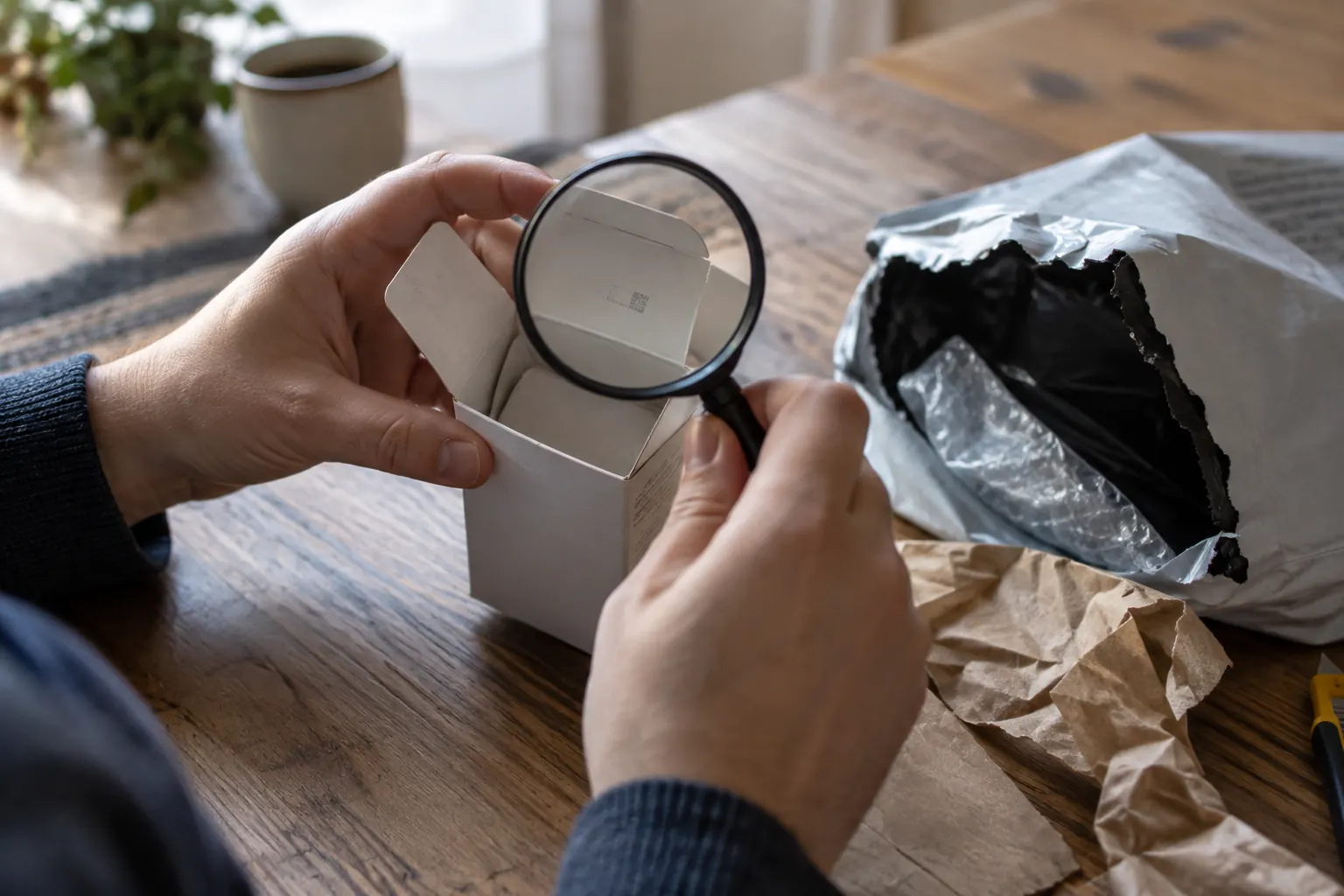
Photograph the package before opening it, then photograph every layer as you go. The details that matter most:
- The shipping label and return address on merchant fulfilled orders.
- Lot or batch code, expiration date and any serial number on the unit and on the outer carton.
- Anything covering those codes: stickers, scratched areas, cut flaps, a relabel over the original label.
- Retail price tags, security tags, or liquidation and returns stickers. Each one names a channel.
- Packaging language and regulatory marks. Foreign language labels or a different ingredient panel usually mean the unit was made for another market.
- Inserts, warranty cards and seals, compared against your current US version.
Keep the unit with its packaging and order confirmation. If this goes to counsel, the unit is the exhibit.
One more thing to try while you have the order. The INFORM Consumers Act says that if a high volume seller used a different business to supply the product a consumer bought, the marketplace must disclose that and, at the consumer's request, give that business's name, address and contact information. That covers the business that supplied the order, which may not be the original wholesale source, but you are the buyer of record and asking costs nothing.
Step 4: Read the codes against your shipment records
The unit only points to a leak if its codes mean something in your own records. This is where the real gap usually shows up: the brand prints lot codes for quality control, but nobody wrote down which lots shipped to which customer.
Lot and batch codes
Start by logging the lot numbers on every outbound shipment against the invoice and the customer. With that log in place, a test buy lot code narrows the leak to the accounts that received that lot. If a lot went to one distributor, you have a name. If it went to eight, you have a shortlist, and a second test buy from the same seller often narrows it further.
Serialization
A unique code per unit, or per case, turns the shortlist into a single account, because each serial was shipped to exactly one customer. It costs more to set up than a lot code, and it is the version that settles arguments.
Covert marking
Diverters know about lot codes, which is why some of them remove codes before listing. Covert marks are a backup the diverter cannot see. Coding equipment makers such as Videojet describe using ultraviolet and infrared inks to print codes that are invisible under normal light, specifically to identify product that enters unauthorized channels. A simpler variant is a small, deliberate difference per distributor, such as a code printed in a different position or a different insert version, recorded in your files and nowhere else.
Amazon Transparency
Transparency is Amazon's unit level serialization program. To enroll you need an active Brand Registry account as the rights owner, a registered trademark and a GTIN for each product. Once a product is enrolled, Amazon says every unit must carry a valid Transparency code, or it will not pass the Transparency check. Customers can scan Amazon issued codes with the Amazon Shopping or Transparency app to verify authenticity.
Transparency is built to stop counterfeits. A genuine unit that leaked from your own distributor carries a valid code, so it passes. Its tracing value is the serial itself: if you record which codes went to each customer, a test buy serial maps straight back to an account. That mapping is your own record keeping.
When the codes are missing
A unit with its production code removed or defaced is evidence in its own right. In Zino Davidoff SA v. CVS Corp. (2009), the Second Circuit held that selling genuine products from which unique production codes had been removed could be trademark infringement under the Lanham Act, where the codes served legitimate quality control and anticounterfeiting purposes. Whether that reasoning applies to your product depends on how your coding system works and where the case would be heard, so treat this as legal information to raise with counsel, not advice.
Step 5: Match the evidence to the leak
Most traces end in one of a handful of patterns. The evidence usually tells you which one you are looking at.
- A distributor selling outside its channel. Recent lot codes, clean packaging, often full case quantities, and a lot that went to a small number of accounts.
- Retail clearance and returns. Retail price tags, security stickers, liquidation labels, scuffed outer packaging, and older lots. The retailer did not sell to the Amazon seller directly. A liquidator in between did.
- Overseas diversion. Foreign language labels, a different formulation or pack size, or import stickers. This one usually follows a price gap between markets.
- A wholesale account that is really an Amazon seller. Order volume that does not match the account's own store or foot traffic, and ship to addresses that turn out to be prep centers.
- Counterfeit. A code that does not exist in your records, a serial you already saw on a different unit, or packaging that does not match any production run. This is the only pattern where a counterfeit report to Amazon is the right tool.
Log each finding next to the seller ID and the order number. Over a few months the log shows which doors leak repeatedly.
Unknown names on your offer list?
Karimex is an authorized distributor on Amazon for a small number of brands. We watch the offer list daily and document every unknown seller on the listings we carry. If you are tracing sellers by hand, we should talk.
Get in TouchStep 6: Act on the source
What you do next depends on where the trail ended.
If it ends at one of your own accounts, you have a contract to work with. Your distribution agreement or reseller policy should say where product may be resold and what happens when it is not. If those terms are thin, how to write a MAP policy walks through the clauses that make a consequence enforceable. Apply the consequence the policy names, document it, and apply it the same way the next time. Termination is a legitimate end point, and it is also the step where a short call with counsel is worth the fee.
If it ends at retail clearance, the fix sits in your retail terms. Returns and overstock need a written path, such as buyback or certified destruction. A retailer that sells your product to a liquidator often just has no instruction telling it otherwise.
If it ends overseas, the tools are different. Under US law, the first sale doctrine generally lets anyone who bought a genuine product resell it. The main exception is material differences. As Mayer Brown summarizes it, the difference can be physical, such as formulation or labeling, or nonphysical, such as warranty or service after the sale. For goods first sold abroad, the same summary notes that Section 526 of the Tariff Act lets trademark owners block entry at the border. Both routes need a lawyer and a documented difference, which your test buy provides.
If it keeps ending at different places, the problem is the number of places. Every wholesale account is another door. This is the argument for controlled distribution on Amazon: fewer accounts, clear channel terms, and one accountable seller on the listing, so that any new name on the offer list stands out on day one.
What not to do
The fastest way to lose ground in this process is to use Amazon's reporting tools for something they were not built for.
Amazon's Report a Violation tool, available to brands in Brand Registry, is for intellectual property infringement, store policy violations and regulatory compliance concerns. A genuine product resold without your permission is none of those by default. Filing it as counterfeit to get a faster removal is a tempting shortcut, and it carries real risk:
- Your tools depend on your accuracy. To qualify for Project Zero, Amazon asks for at least a 90 percent acceptance rate on your Report a Violation reports in the last six months. Once enrolled, a brand must keep an accuracy rate of at least 99 percent to keep the self service counterfeit removal tool. Inaccurate reports cost you the tools you need for real counterfeits.
- Amazon screens notices. In its 2024 Brand Protection Report, Amazon says it intercepts invalid notices of infringement at submission and that the process also blocks notices from bad actors trying to misuse the reporting system against competitors.
- Abusive filing has consequences. KJK, a law firm that works with Amazon sellers, reports that Amazon's Counterfeit Crimes Unit has pursued parties that used invalid or fraudulent trademark registrations to file abusive takedown requests, and that targeted sellers may have claims such as tortious interference or abuse of process.
One smaller mistake is worth avoiding too. Do not send an unauthorized seller legal threats that your contracts and the law do not support. When the seller calls the bluff, you lose credibility with every other seller watching.
Investigate first, act on the contract you have, and file with Amazon only on what the unit in your hand shows. For the price side of the same problem, how to enforce MAP pricing on Amazon covers the enforcement ladder for the sellers you do supply.
Frequently asked questions
How do I find out who is selling my product on Amazon?
Open the seller's profile from the offer list. Amazon shows the business name and address there, and the INFORM Consumers Act requires disclosure for high volume sellers with $20,000 or more in annual gross revenue on the marketplace. Record the seller ID from the page address, because names can change.
Will Amazon tell me where a seller gets its inventory?
No. Amazon's reporting tools cover intellectual property, policy and compliance violations, and sourcing is not one of them. You find the source yourself, with a test buy and your own shipment records. The INFORM Act does let a buyer request details of a different business that supplied their order, which is worth asking for after a test buy.
What is a test buy and why does it matter?
It is an ordinary purchase from the seller you are investigating, made from an account and address not tied to your brand. The codes and packaging on the unit show which channel it came through, and the unit is your evidence before you act.
What if the seller removed the lot codes?
That is a finding, and you should document it carefully. In Zino Davidoff SA v. CVS Corp., the Second Circuit held that selling genuine goods with their quality control codes removed could infringe the trademark. Talk to counsel about whether that applies to your product. Covert marks that the diverter cannot see are the practical backup.
Does Amazon Transparency stop unauthorized sellers?
It stops units without a valid code once a product is enrolled, which targets counterfeits. A genuine unit that leaked from your channel still carries a valid code and passes. The tracing value comes from recording which serials shipped to which customer, so a test buy serial points to one account.
Can I report an unauthorized seller as counterfeit to get them removed?
Only if the unit is actually counterfeit. Counterfeit claims against genuine goods are inaccurate reports, Amazon ties tools like Project Zero to high accuracy, and the seller may have legal claims against you. Trace the source and act on your contracts instead.
Sources
This article is general information about Amazon programs and US law, not legal advice. Program rules change, so check the current pages before acting.
- Amazon Seller Forums (News_Amazon): Advance notice: Business name and address to be displayed on the seller profile page starting September 1, 2020
- Federal Trade Commission: Informing Businesses about the INFORM Consumers Act
- Federal Trade Commission: What Third Party Sellers Need to Know About the INFORM Consumers Act
- Amazon Seller Forums (News_Amazon): Commingling practices will end effective March 31, 2026
- Sell on Amazon: Amazon Transparency
- Sell on Amazon: Project Zero
- Sell on Amazon: How to report a violation to Amazon
- Amazon: 2024 Brand Protection Report
- Videojet: Fighting the battle against brand counterfeiting and diversion (technical guide, PDF)
- FindLaw: Zino Davidoff SA v. CVS Corporation, 571 F.3d 238 (2d Cir. 2009)
- Mayer Brown: Navigating the Gray Market Landscape (October 2025)
- Kohrman Jackson & Krantz (KJK): Amazon Brand Registry Abuse: What Sellers Need to Know (June 2026)